
The Hidden Map: Where ANA and JAL Don’t Compete
Japan’s domestic aviation map looks unified at first glance, but beyond the major hubs lies a quieter world where ANA and JAL each hold exclusive territory. From ANA’s remote northern outposts like Rishiri and Wakkanai to JAL’s island lifelines in Amakusa, Yakushima, and Yonaguni, these one‑airline airports reveal how geography and history shape Japan’s skies. This guide breaks down ANA‑only and JAL‑only destinations across eastern, central, and western Japan to help travelers plan smarter and earn miles more strategically.
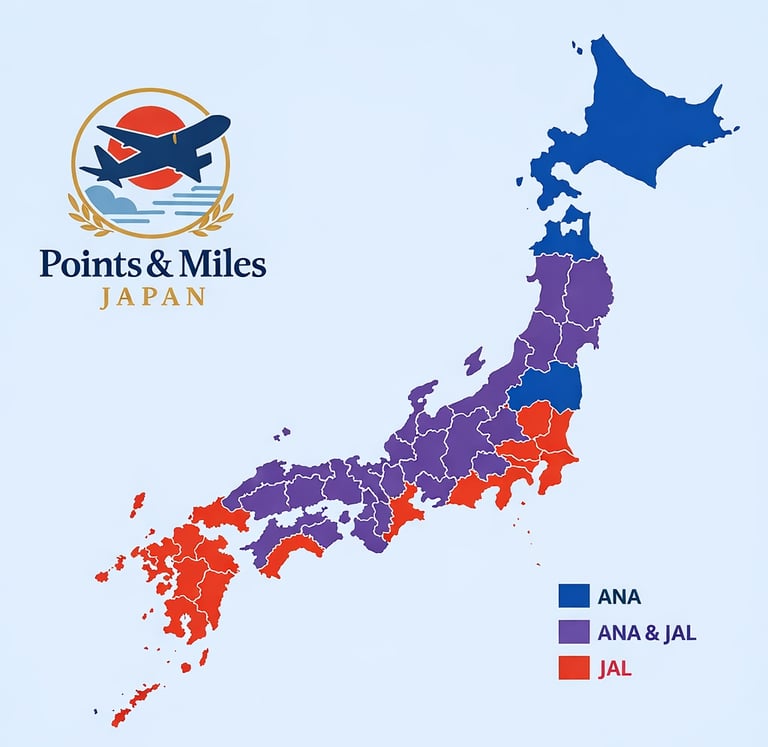
Japan’s tourism boom has brought millions of visitors back into the country, but most of them still gravitate toward the familiar: Tokyo’s neon lights, Osaka’s food culture, Kyoto’s temples. These cities absorb so much attention that the rest of Japan—its regional hubs, remote islands, and quiet coastal towns—often remains invisible to international travelers. Yet when you look beyond the Golden Route and study Japan’s domestic flight network, a fascinating pattern emerges: ANA and JAL don’t always compete. In fact, each airline has its own pockets of exclusivity scattered across the country.
Some of these exclusives are shaped by geography. ANA, for example, uniquely serves Rishiri and Wakkanai, two of Japan’s northernmost airports, where harsh winters and low population density make dual‑airline service impractical. JAL, on the other hand, dominates smaller island airports like Amakusa, Yakushima, and Yonaguni, where turboprop operations and regional partnerships keep these communities connected to the mainland. These aren’t just routes—they’re lifelines.
Zooming into eastern Japan, ANA holds several important regional gateways: Sendai, Shonai, and Fukushima are all ANA‑only airports, anchoring the airline’s presence across Tohoku. JAL’s exclusives in the region—Yamagata and Odate‑Noshiro—tend to be smaller but deeply tied to local travel patterns. In central Japan, ANA maintains exclusivity at Shizuoka and Toyama, while JAL controls Nanki‑Shirahama and Tajima, airports that serve niche tourism and rural communities. Further west, ANA’s reach extends to Iwakuni Kintaikyo and Hagi‑Iwami, while JAL connects the remote Oki Islands and culturally significant Izumo.
These patterns aren’t random. ANA often anchors medium‑sized regional hubs, while JAL leans into rural airports and island communities—roles shaped by decades of route development, aircraft type specialization, and regional government partnerships. And while both airlines compete fiercely in major cities, their exclusive territories reveal a quieter, more strategic side of Japan’s domestic aviation landscape.
For travelers—especially those navigating miles and points—understanding these one‑airline airports matters. It determines which loyalty program you’ll rely on, which award charts apply, and how flexible your itinerary can be. Japan’s domestic network is far more nuanced than the well‑trodden routes between Tokyo, Osaka, and Kyoto. Once you understand where ANA and JAL don’t compete, the map becomes clearer—and your travel planning becomes a little more intentional.