SoftBank’s Flight of Fancy
SoftBank may have been left out of ANA and JAL’s mobile ventures, but the story doesn’t end there. This article speculates on which foreign carrier might become SoftBank’s partner in an airline‑linked service. Could it be Delta, with its innovation streak, or Singapore Airlines, with its premium digital edge? With global investments and a disruptive brand image, SoftBank’s next move could reshape the loyalty game. A light, imaginative exploration of how SoftBank might still take flight in the airline‑mobile space.
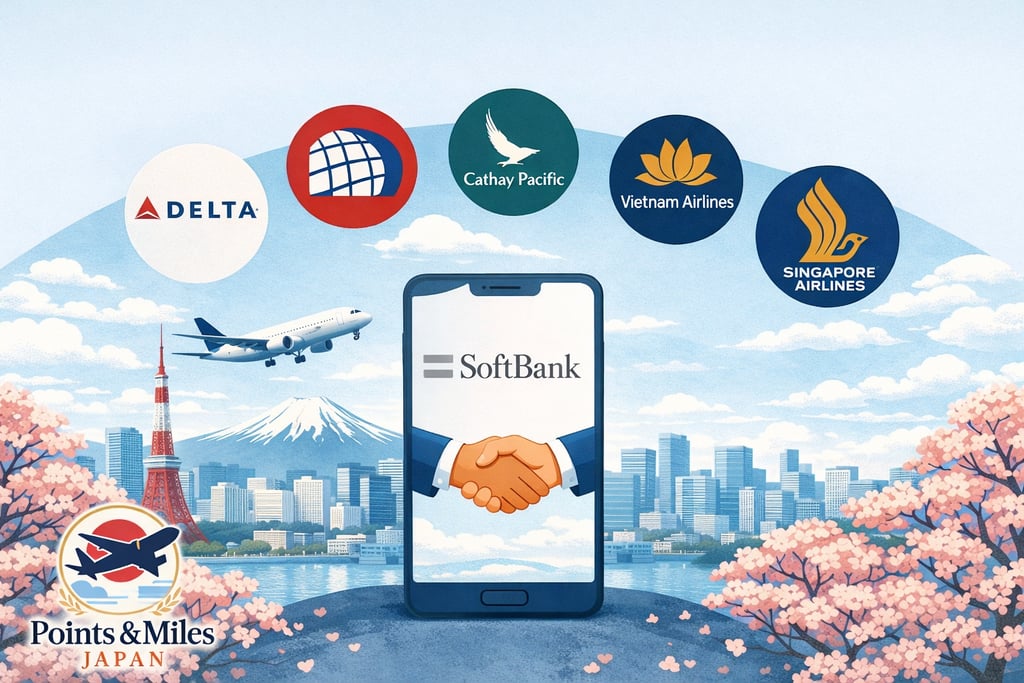
SoftBank may have been left out of ANA and JAL’s mobile ventures, but anyone who knows Masayoshi Son’s empire understands: SoftBank never stays grounded for long. With its global investments and disruptive streak, the company could still take flight—just not with Japan’s flag carriers. Instead, the runway may lead to foreign airlines already embedded in Japan’s loyalty ecosystem through co‑branded credit cards.
United Airlines: The Trans‑Pacific Powerhouse
United Airlines has one of the deepest footprints in Japan among foreign carriers. Its MileagePlus program is tied to multiple co‑branded credit cards—JCB, MUFG, Saison, Diners Club, UC—offering up to 1.5 miles per ¥100 spent. For SoftBank, this is a perfect match. Imagine a SoftBank Mobile plan where your monthly bill earns MileagePlus miles, stacking alongside your United credit card spend. With SoftBank’s Vision Fund investments in U.S. tech companies, a United partnership could create a Japan–U.S. lifestyle ecosystem, blending telecom, payments, and travel rewards.
Cathay Pacific: The Asia Miles Connector
Cathay Pacific’s Asia Miles program already has a presence in Japan through the MUFG Gold Mastercard, which earns 1 Asia Mile per ¥100 domestically and 1.5 overseas. Asia Miles is versatile, redeemable across oneworld partners—including JAL. SoftBank could integrate Asia Miles with its PayPay platform, allowing customers to earn miles from everyday purchases and mobile bills. Picture a Tokyo professional paying for lunch with PayPay, then watching Asia Miles flow into her Cathay account. For urban, international travelers, this would be a payments + telecom + travel synergy unlike anything else in Japan.
Vietnam Airlines: The Southeast Asia Corridor
Vietnam Airlines, through its Lotusmiles credit card with Sumitomo Mitsui Card (SMCC), already offers Japanese customers 1 mile per ¥100 spent. With strong travel demand between Japan and Vietnam, and existing cooperation with ANA, SoftBank could position itself as the telecom partner for Southeast Asia flyers. Imagine a SoftBank Mobile plan bundled with discounted Vietnam Airlines tickets, appealing to cost‑conscious travelers and expats. This would carve out a niche market where SoftBank thrives—urban, price‑sensitive, and globally connected.
Delta Air Lines: The Innovative Challenger
Delta has historically offered co‑branded cards in Japan, often with American Express. Known for loyalty innovation—think Lyft rides and Starbucks purchases earning SkyMiles—Delta could align perfectly with SoftBank’s disruptive image. A SoftBank–Delta partnership could introduce creative lifestyle bundles, where mobile bills, ride‑sharing, and coffee runs all funnel into SkyMiles. For younger, urban consumers, this would feel fresh and dynamic, setting SoftBank apart from ANA and JAL’s more traditional offerings.
Singapore Airlines: The Premium Digital Partner
Singapore Airlines, while less entrenched in Japan’s credit card market, carries immense prestige. Its KrisFlyer program is globally respected, and the airline is known for digital innovation. SoftBank could leverage its Asia‑Pacific investments to build a premium telecom + travel bundle, appealing to high‑end Japanese consumers who value exclusivity. Imagine a SoftBank Mobile plan that not only earns KrisFlyer miles but also offers priority booking for Singapore Airlines’ premium cabins. For SoftBank, this would be a bold play into the luxury segment.
Conclusion: If SoftBank wants scale and credibility, United Airlines is the strongest candidate. For urban lifestyle synergy, Cathay Pacific stands out. For niche corridor appeal, Vietnam Airlines offers a unique angle. Delta and Singapore Airlines remain attractive for their innovation and premium branding, but would require more groundwork in Japan.
How a SoftBank partnership would be implemented: Unlike ANA Mobile and JAL Mobile, which operate as MVNOs on Docomo and au networks, a SoftBank partnership would likely be directly integrated into SoftBank’s own infrastructure.
This means:
No MVNO leasing: Customers would be on SoftBank’s native network, avoiding the peak‑hour slowdowns common to MVNOs.
Deeper loyalty integration: Monthly bills would accrue foreign airline miles (MileagePlus, Asia Miles, Lotusmiles, SkyMiles, or KrisFlyer), directly tied to the carrier’s loyalty program.
Bundled perks: SoftBank could combine PayPay discounts, credit card bonuses, and telecom rewards into one seamless package.
Global roaming focus: Unlike ANA/JAL Mobile, which are Japan‑centric, SoftBank’s foreign airline partner would emphasize international connectivity—roaming discounts, overseas Wi‑Fi bundles, and cross‑border promotions.
Lifestyle tie‑ins: Expect creative bundles—coffee purchases earning SkyMiles, e‑commerce transactions feeding Asia Miles, or family plans pooling Lotusmiles for Southeast Asia trips.
In vivid terms, a SoftBank partnership would feel less like a “domestic airline SIM card” and more like a global lifestyle passport. Where ANA Mobile and JAL Mobile tether you to Japan’s skies, SoftBank’s airline‑linked service would tether you to the world—your phone bill becoming a boarding pass to international adventures.